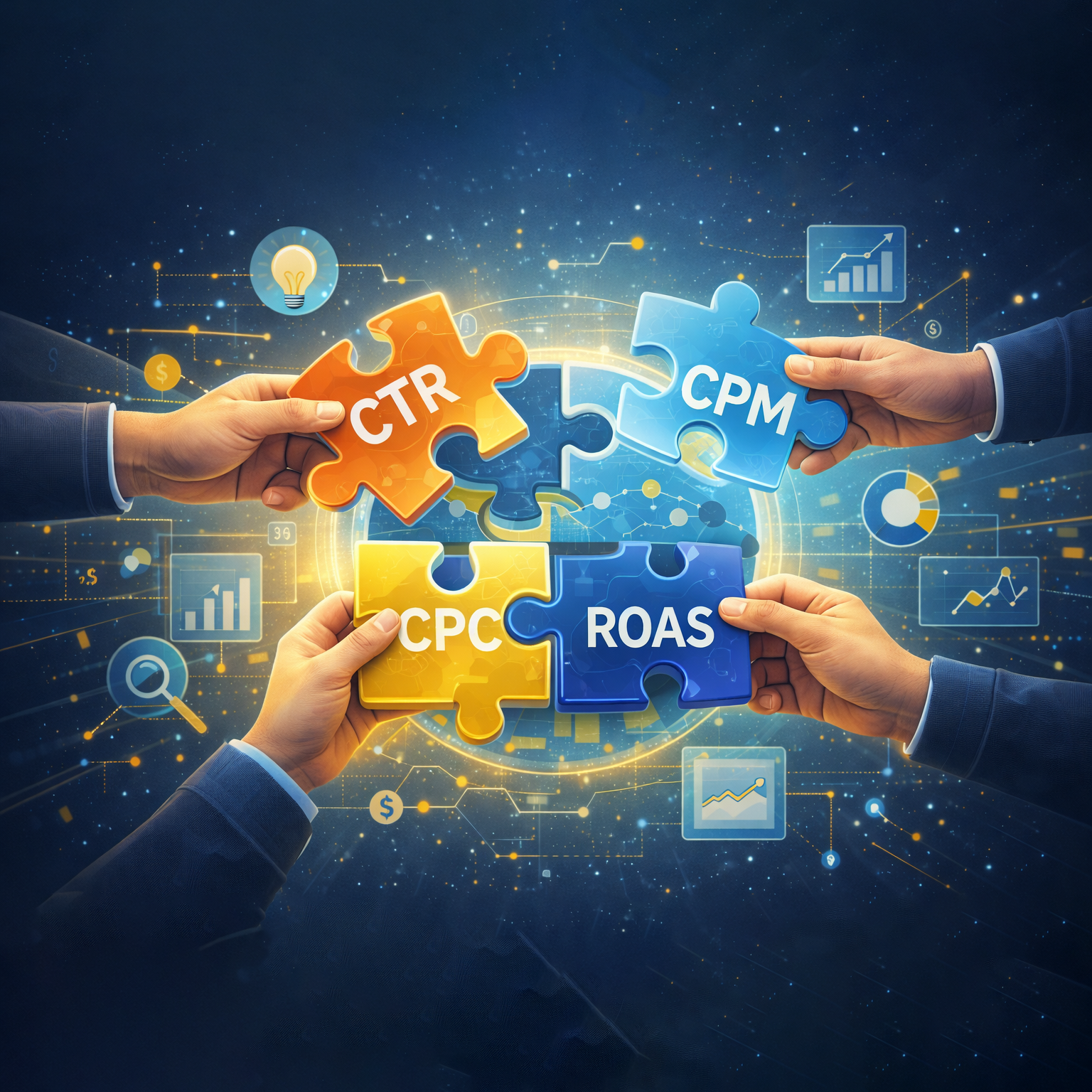
For years, certain metrics in digital marketing have been established as almost automatic indicators of success. Numbers that are easy to show, understand, and compare. But when analyzed in isolation, many of these metrics can tell an incomplete story.
The problem is not the metrics themselves, but how we interpret them
Take CTR as an example. At first glance, a high CTR may seem like a great signal: it means many people clicked on an ad. But what happens after the click? If those users do not convert, leave no data, or quickly abandon the page, that strong CTR loses its value. It may even indicate a mismatch in expectations: an attractive ad that does not align with the post-click experience.
Something similar happens with CPC. A low cost per click is often celebrated as media buying efficiency. And to some extent, it is. But if those clicks lack quality, if they do not come from a relevant audience, or if they do not generate valuable actions, the savings are only apparent.
Another commonly misunderstood metric is CPM. Campaigns are often optimized solely toward lower impression costs under the logic of “reaching more people for less money.” But a low CPM does not guarantee real impact. You might be paying little to show ads that no one notices or that generate no interest. In some cases, a higher CPM can actually be more efficient if it means a better audience or a higher-quality environment.
ROAS also falls into this logic. It is undoubtedly one of the most important metrics when the objective is sales. But looking at it in isolation can lead to short-term decisions. A campaign with a high ROAS may only be capturing existing demand—users who were already ready to buy—without generating real future growth. Without complementing it with awareness or consideration strategies, the result may be short-term gain but long-term stagnation.
Even more “business-oriented” metrics like CPL can be misleading without deeper analysis. Not all leads have the same value. A low CPL may hide form submissions from users with no real interest, while a higher CPL may bring in more qualified prospects closer to conversion. Without this qualitative perspective, optimization can move in the wrong direction.
Then there is one of the most seductive metrics: reach. Seeing large numbers creates an immediate sense of success. But reaching many people does not necessarily mean generating impact. The key question is not how many people you reached, but who you reached and how often. Without relevance and sufficient frequency, reach quickly loses effectiveness.
All of this leads to a central point: no metric should be analyzed on its own
Metrics work as a system, not as independent indicators. They complement each other, explain each other, and make sense when aligned with a clear objective. A high CTR with low conversion may signal a landing page issue. A high volume of leads with low quality may indicate overly broad targeting. And so on.
That is why, before looking at any number, the question remains the same: what are we trying to achieve?
If the objective is awareness, metrics like reach, frequency, or CPM make sense—but always alongside attention or recall indicators. If the objective is performance, then conversions, CPL, CPA, or ROAS come into play, without losing sight of quality and sustainability.



.png)